So it happened. The U.S. government is shutting down. A lot of people are writing a lot of things about what this means, but I’m awake and restless at 4am, so here’s a quick take on what it means for me personally.
Forget that our pay has been frozen for three years. Forget that I was already furloughed without pay for over a week last year due to sequestration. Forget that I’m among the 20% or so of federal workers who are deemed “non-essential.” We will likely not get paid for however long it takes Congress to figure out how to do their job. And forget that even if they decide to make us whole again (like they did in the 1990s) that they will most likely end up taking some or all of it back to meet sequestration.
These are my sacrifices, and I can deal with them. The thing that upsets me most is that is the damage that this uncertainty has done to my ability to do my job. My job is a very, very small piece of the government puzzle, but I think it is important to share how removing this piece affects the world outside my little cubicle.
First, bear with me as I tell you a little about my job. I manage grants to local governments to improve their water and wastewater infrastructure. The funds for these grants were appropriated by Congress back in the days of pork barrel earmarks. By law, the money must be spent on these projects. My job is to make sure the funds are used responsibly and provide an environmental benefit. At times the work can seem frustratingly administrative and bureaucratic, and I might even wonder occasionally if it is how I want to spend my career. But I recognize that it is important for someone to be there, protecting taxpayers from waste and protecting the environment from harm.
I also spend a portion of my time working directly with water and wastewater utilities to help them manage their energy usage. The benefits from this work are broad and deep. Reducing energy use means more than just saving money and reducing carbon and reducing the environmental ills caused by producing our energy. It means that these utilities will be able to reinvest this money improving their infrastructure or retaining employees without having to raise rates for their customers. Last year alone, four of these utilities saved 5.5 million kilowatt-hours of energy -- this is equivalent to the annual electricity used by about 530 homes. These utilities kept about $500,000 that would have otherwise gone to the power company. We’re currently in a critical period where we are trying to scale up these results and get similar programs going in two other states.
But all of that is on hold for now. Or at least I presume it is. As of this writing, I still have yet to receive official notice that I am on furlough. But the costs of the shutdown are already piling up. Here are a few examples:
The threat of a shutdown makes any kind of planning pretty meaningless. I spent a lot of time this week canceling meetings, canceling commitments, and dealing with a lot of contingencies. This is time that could have been better spent. If in the next few hours Congress passes a bill and funds the government for the next six weeks, it is likely I will spend more time rescheduling those meetings and commitments. But even then, how meaningful will those meetings be when it is possible this will all happen again in less than two months?
I was scheduled to attend the WEFTEC conference next week. This is where water professionals gather to share ideas, learn the latest, and find common interests. I cannot stress enough how important it is for EPA to be represented there. It is our ticket out of the “echo chamber” that critics of government are always complaining about. If we are shut down, not only will I miss the boat, but the government will have to pay various fees for my cancelled reservations. Again, if we’re back in business by the end of the week, I’ll be cleared to travel, but all the cheap hotel rooms will probably be gone, and Uncle Sam will be out of more money.
Much of my time this last week has been spent going to meetings about what I should expect in the event of a lapse in appropriations. Again, this is time that I would have rather spent doing my job.
Try as I might to be a good patriot and give my all to this job, it was really hard to find the motivation yesterday. When politicians (and the electorate who put them in power) regularly send the message that you're not important enough to pay, it really hurts morale. I'm sure I'm not the only one who feels that way. And it makes it easier to spend a few minutes reading the latest news or commiserating with your coworkers instead of working on the things that really matter. I know that my contribution to this cost is fully within my control, not Congress', and ideally I wouldn't have to list it here; but expecting otherwise is just unrealistic.
These are the costs that really frustrate me. I know there are many more examples but I don’t have time to enumerate them. In an idiomatic governmental irony, I now have to go to work to find out that I can’t go to work. Let me know if you wanna hang out.
Remember when it was discovered that directions from Google maps suggests kayaks and jet skis for crossing large bodies of water? Well I do. And if you don't here's an example:
Charming, right? Now, if I may be so bold, I'd say the engineers behind this feature missed an opportunity. Witness the disappointing results when I ask for walking directions from Mount Katahdin, ME to Springer Mountain, GA:
Everyone knows the best way to get from A to B on foot is the Appalachian Trail! There's even a ripe pun for the picking. The advisory circled in the image could (should) read "This route includes a Harpers Ferry."
This is kind of old news, but I thought I should follow up on it. Edward Vielmetti put up a nice slideshow of a diver suiting up and taking the plunge. Reports say they yanked out concrete blocks, some shopping carts and a motorcycle from one of the intakes. A second intake is clogged and will remain so until spring, but it appears the zebra mussels have been vindicated for the time being.
I'd also like to point out that his latest article uses a hydrograph identical to the one I generated for my last post. This is an improvement from his original article on Jan 26th, which was similar to the one in the HRWC article I linked to. I'd like to believe he took the cue from me, but I' doubt it. In any case, I'm always happy to see science get communicated properly.
Edward Vielmetti has been following the recent erratic behavior of Argo Dam the last week or so. The Huron River Watershed Council, among other groups, has been advocating for removing the dam to help save the City money and improve the river's ecology. I think the plan makes a good deal of sense, but recently took a blow when city council voted 10-1 to approve a 3.1 million dollar project to repair the dam and construct a whitewater headrace. I suspect this decision was probably meant to appease the owners of expensive property that borders Argo Pond - the removal of the dam would cause Argo Pond to recede and give the property owners a nice fertile valley in lieu of waterside property. But that's just a hunch.
In any case, the HRWC posted an article about the recent malfunctions and their effect on the river ecology. The article included a nifty hydrograph (a graph of the river's flowrate) from the USGS, reproduced below.
But unless you're used to looking at hydrographs, it's hard to tell that this is absolutely nutty. So here's another plot over a longer time frame that gives you a better idea of what this looks like in the context of more 'normal' behavior. Presto:
Vielmetti's latest article says that the zebra mussel, the archetypal invasive species, is suspected for the malfunctions. Makes you wonder when decision makers will start listening to the recommendations of environmental scientists.
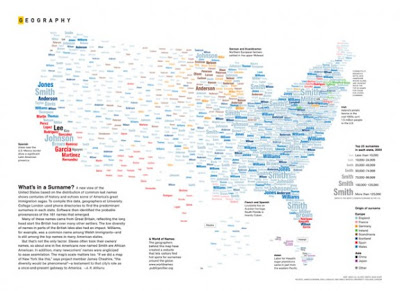
In the "Give & Take" post, I went into a small part of the importance of diamou, or tribal names, in Mali. I would often get asked if/how many diamous are in America, and I always struggled with the answer. There are of course the Native American tribes, but I don't think there is the same kind of joking relationships that Malian tribes enjoy, and lumping all the anglos together doesn't do justice to the variety therein. Last names, on the other hand, seem too numerous to really create the same kind of team mentality that seems to be inherent to the diamou.
I don't know if this map will totally answer the question, but it goes a long way. It's a geographical tag cloud of last names, color-coded by ethnic origin. Pretty cool.
I was horrified by the terrible crimes reported by ABC News last week. What happened to those women is a tragedy and they are incredibly brave for sharing their stories. I am troubled, too, by the apparently apathetic and negligent treatment of the incident by the Peace Corps staff in the countries concerned. While the official statement addresses some of these concerns, I'll be looking forward to further action in response to those allegations.
In the meantime, I've gathered from various commentthreads and personal conversations that the general reaction to these reports includes a tendency to presume that Peace Corps service inherently carries greater risk for sexual assault and rape relative to life here in the United States. I don't believe this is the case.
According to the ABC report, there have been about 1,000 cases of sexual assault and rape reported by Peace Corps volunteers over the last decade. About 3,500-4,000 Peace Corps trainees go abroad every year. For the sake of argument, let's make the conservative assumption that only half of these 3,500 trainees are women. (In reality, 60% all volunteers are women - most, but not all of which are recent college graduates.) 1,000 incidents over a ten year period among 17,500 women over comes to a 5.7% rate of incidence. Compare this to the United States, where up to 25% of college age women report surviving rape or attempted rape since their 14th birthday. (14-22 is only 8 years, but it's been a while since I took stats, so I'm not sure how to correct for this. Regardless, the absolutely correct value would never approach 5.7%.) I've been told that the statistics for murder and assault are similarly lopsided.
So let us not confuse the issue. As I said, the reported unresponsiveness and victim-blaming of the local staff is of great concern and deserves scrutiny. But there is nothing inherently unsafe about being abroad or working as a Peace Corps volunteer. The same terrible things can and do happen here, and it's just as tragic.
'Cus even in Madagascar, we'll find some shack below radar -Gogol Bordello Back in early 2009, when things were beginning to turn sour in Madagascar, I remember being frustrated when Google news couldn't feed my information addiction regarding the pending coup. English-language articles that came up from a search of 'Madagascar' were mostly about the release of 'Madagascar: Escape 2 Africa.' Though this would soon be hilariously ironic, I couldn't figure out why this was more news-worthy than a tempest of cyclones, looting and massacres. I still don't know why it didn't get covered as extensively as it might have, but I've been looking at Google trends, and it seems to validate that it was bad coverage, and not my information withdrawal, that sent me into such anxious fits at the internet cafe.
Here's the first plot, showing web traffic and news reports for Madagascar since 2004, to give you an idea of how coverage of the movies compares to the coup. (Click on any of the images below for a larger view.)
The first thing to notice is the relative size of the peaks in overall traffic, at 'A' and 'B,' to the average level of traffic and subsequent coup traffic. Notice that peak A is quite wide -- beginning around the 'Madagascar' release on May 27, 2005 and taking until mid-2006 to return to a normal traffic level. It also has a secondary peak corresponding to the DVD release on November 15, 2005. Since the release of the second film overlapped with the period of turmoil, we'll just have to assume that the traffic peak for the second movie at 'B' has similar traits. This means that when we look at traffic for 2009, the high baseline at the beginning of the year is mostly residual activity from the movie release on November 7, 2008. Also worth mentioning is that the news coverage, shown on the bottom line, was fairly responsible -- small peaks for the movies relative to the day of the coup.
This next figure we zoom in on 2009. Remember, the high traffic volume at the beginning of the year is residual buzz from the movie.
Here we see some stranger behavior from the news publishers. There's a small hiccup in late January, when the looting and shootings took place, which in my mind were the most intense moments of the period. Yet the greatest news activity only happened when the president peacefully stepped down on March 17.
So far, we've seen that web users care more about movies than Malagasy murders, regardless of how much noise the news makes. We also might hypothesize that the internet-based media mailed this one in. It missed all the real action and mostly covered an event that was pretty much a forgone conclusion in the minds of anyone paying attention. But is this true everywhere? How do other coups stack up?
Honduras suffered a coup in June 2009, just 3 months after Ravolomanana stepped down. I've graphed activity for Honduras and Madagascar in 2009 on the same chart so that we can see the relative intensity of the coverage.
All of a sudden, that huge spike on March 17 looks like a speed bump next to the Honduran Himalayas. This makes sense. To get to Madagascar from the east coast of the United States, you need 19 hours and $5000. Also there are probably more American expats in Honduras and Honduran expats in America than is the case for Madagascar. You can't report what you don't see.
But come on - there were more articles written in Romanian than in English about the crisis in Madagascar. Romanian! I don't even want to think what that would look like in terms of articles per fluent capita!
Certainly, there's a lot this data can't account for. (Was the coup in Honduras more unexpected and sensational? Is there a disparity of the level of access to telecommunications in the two countries? What effect did World Cup qualifiers have on the traffic?) But I can't help but wonder if there's a certain amount of negligent laziness that determines the news we see and the news we don't. What do you think? And seriously, what's the deal with the Romanians?
“We can break the rules like nothing will last. You might forget the sound of a voice, Still you should not forget the things that we laughed about.” -LCD Soundsystem “Friendship sucks.” -Dugukolo Coulibaly
Goodbyes are never easy, and this was no exception. I cried. Everyone cried. And in Mali, crying is intolerable, so we all had to tell each other how badly we were behaving. I’ll miss N’gabakoro deeply. And that’s all I have to say about that.
It had been a bad week.I’d just recovered from another bout of diarrhea.This one even made the Peace Corps doctor say ‘ew’ when I described my symptoms to her over the phone.Maybe the poor woman was eating breakfast or something; I never think of these things in time.
Now, as a native of Michigan – an Arborigine goddammit! – and a part-time Yooper, it’s my birthright to deny, or at least impugn the existence of cold anywhere else on the planet, particularly in the bloody tropics.I’d already gone to great lengths to explicate my standards for cold:
Little pieces of ice fall from the sky and pile up on the ground until people get lost in it! We put metal ropes on our car tires that bite the ice so we can go places.Some people don’t have houses and burn garbage to stay warm.And, when the river freezes, some crazy people build small houses on the ice, drill holes in it and wait for stupid fish to jump out of the cold water below!
So, “No,” Madou lies, “I already told you, cold doesn’t exist in Mali. I just like my blanket.”
This precipitates a conversation that reveals one of the most perplexing misconceptions about America I’ve yet had to face. Are you ready?
Mali’s cold is bad.
America's cold is good.
By this point I’ve already talked down ridiculous claims like "America is rich is that she prints all of the world’s money," and "Mali can’t manufacture airplanes because America won’t teach her" and "Michael Jackson took medicine to turn white because he didn’t like being black" and even "George W. Bush personally executed Saddam Hussein."But this one left me speechless. So I asked Bafing what he means.He said that no matter how bad it is outside, the cold doesn’t get in our houses.He said that we don’t have dust storms that make people sick.He said that if we do get sick there's cheap and unexpired medication we can take that lets us do our work anyway. By the time he's done, I’ve privately admitted to myself that even our friends in the economically challenged Upper Peninsula have it pretty good.But I’ve made little to no headway conveying the hardships faced by snowbound Americans.Part of this is due to my linguistic shortcomings, but I have a tendency to make this harder for myself than it needs to be.My anecdote about Hugo Chavez's donations of heating oil to the snowbound northeast was especially confused.
But through these conversations I also begin to see an upside to the ridiculous barriers our government puts in place to limit immigration to the educated elite. Sometime you should ask someone from a less developed country what they had to do to get their visa, you'll be astounded by the barriers they have to overcome.But in some ways, it serves a purpose. By the time someone has money, computer skills, and contacts in the United States, their dreams of America tend to be fairly grounded in reality. Yes, it's a place where opportunities exist, but they’re not distributed evenly. Yes, there is wealth, but there is also poverty, disease, xenophobia and even racism. Even the ones who eventually make it over still have a hard go of it.But every time I try to explain this to the proponents of the Candyland vision of America, they flatly deny it.This kind of reaction has the power to still even the most vivacious and fluent tongues. It’s like if you told a group of children that the Easter Bunny isn’t real, only to have them snap back in unison, “Don’t be silly. You’ll find out one day.”
You start to ask yourself, what is it they know???
Speaking of the Easter Bunny, this spring I’ll get my 3rd chance to explain the American Easter tradition. Given that “pretend” or “make-believe” aren’t in my Bambara vocabulary, what do you suppose it will do to their vision of Paradise?I can see it now. Years down the road they'll be telling each other Madou said that in America they have giant bunnies. And that every year, they sneak into your house and hide colorful chocolate-filled eggs in every corner because… what did Madou say? Jesus died for us sinners? Amen and hallelujah! I guess we Americans are capable of some pretty stunning self-deception, too.
What struck me as odd about this is that nothing at all about this struck me as odd.
My point being, whether it’s the hot (not cold!) weather, the improbable loads carried on the backs of bicycles or on the heads of women, or the perfectly bizarre creature that is The Donkey, I’m getting used to life here.I guess it’s a good sign that I'm comfortable with my environment.But at the same time, it makes it harder to recognize the "unrelatable" moments, and sharing the things I’ve made sense of seems less urgent.So sorry for that.And sorry again for when I come back to the States and laugh at all the wonderfully absurd things we do.
It’s a like a Wall St. fire drill. Shoving, shouting, and a powerful tide of people running and brushing past from every direction. Peace Corps had warned us not to come here. I’m constantly rubbernecking to keep track of the other volunteers and scanning the crowd as we try to cut across the undertow, but Peace Corps’s advice is kept far from my mind. I’m too busy looking for what everyone is after– a cool drink of water.
It’s halftime at the Mali-Ghana soccer match, and we’re circling the concourse outside the stadium. The sun went down around the twenthy-fifth minute, but the pre-game hours of line standing and seat saving has left me - and 30,000 of my closest friends - a bit parched.
I can say with some confidence that these entirely non-threatening skirmishes were not what PC had in mind when they questioned the wisdom of going to a World Cup qualifier in West Africa, especially when the visitors are heavily favored to win. In fact, just last year a number people got trampled at this very same stadium - and that was just an Alpha Blondy concert!
But here, all has been law and order. The pre-game traffic wasn’t any heavier than you might expect in the States, but the fast and (literally) loose passenger safety regulations meant hundreds of pick-up trucks and vans with dozens of people overflowing from every door, window roof and bumper, each one clutching on to ‘post-market’ and ‘user-installed’ oh-shit bars. Impressive, too, was the line outside the stadium. Lacking any snaking corrals to keep the line compact and single file, a tight line coiled around the stadium. Strangers stood chest to back for easily a kilometer. Police enforced no-go zones on either side of the line by blindly swinging clubs like General Grievous as they paced up and down either side of the line. Those who thought they were too good to conga with the rest of us were quickly corrected. One-and, two-and, one, kick!
And even the current brouhaha isn’t all tooth-and-claw greed. My friends wave me to the outside wall of the concourse overlooking the property behind the stadium. Then I see them – thousands of men, shoeless and prostrate in prayer. Whatever residual tension I'm harboring downshifts two gears. In Madagascar, my friends and I would have had to Houdini out of potentially thousands of handshake manacles and suffocating vapor clouds of ethanol. But not here - every Muslim in sight is sober. The most we'd have to worry about was staying out of the way as they race into the bathrooms, roll up their pant legs and crowd the sinks for the ablutions. After all, Allah waits for no conga line.
As I'm taking in the view, man brushes past, his arms full of the coveted polyethylene pouches of water. The American in me immediately thinks scalper! and I chase after him. When I ask him if he’s selling, he smiles, shakes his head. In an archetype of Malian patience, tries to push one into my hand.
In Mali, it’s impolite to refuse a gift, something that I tend to forget. For example, one morning in Koulikoro, the capital of my region, I’d walked downtown to get breakfast from possibly the best meat & egg sandwich stand in Mali. The woman makes this onion sauce that is at once an aphrodisiac in the short term and a guarantor of abstinence in the long.
On the way, I practiced an obligatory gesture I learned in Madagascar but perfected in Mali – greeting. It usually goes something like this:
Good morning! How’d you sleep? How are you? How’s your family? My name? Madou Coulibaly.
From here, it can go one of two ways. If they, like me, are a Coulibaly, we wish each other a nice day and I’m on my way. If they go by any other last name, I’m told in the warmest tones and with the heartiest of handshakes that I am an uncircumcised slave donkey who farts a lot, or some permutation thereof. It’s a complicated relationship.
I'd finally made it to the sandwich stand and had begun the trip back home. I'm cradling the warm sandwich like a football to keep any onion sauce from escaping the baguette. One of the not-Coulibalys I identified earlier hollered from across the street. Where are you going with that? Coulibalys are too poor for anything but beans! Give it here. Feeling a little insult fatigue, I decided to call her bluff. I crossed the street, marched up the steps and I was halfway into my play-action pass before I realized it wasn't what either of us had intended. But it's too late. So inexorably, with my confusion mirrored in her face, she took the sandwich.
Likewise, back at the soccer game, with a well-practiced smile of resigned gratitude, I take the water.
****************
Mali eventually lost, 2-0, so thankfully halftime was as lively as things got for us. Granted, we left after the second goal, and even then we had to battle our way through congested streets with no public transport in sight. We had the good fortune of being picked up by a Malian couple driving a luxury SUV paid for in diamonds. “It's nothing,” the woman said. “Somewhere in America, I’m sure someone is doing the same for a Malian.” My mind ran through the particulars of a wealthy American couple picking up five West Africans from the streets of DC in the dark of night, and I briefly considered contending her assertion. Once again, good fortune intervened and a combination of inadequate Bambara and nearly adequate judgment kept my tongue in check. It’s easier to pay it forward from here.
I’ll admit, I flipped the switch too early. Sometime during that bumpy, dusty, overnight truck ride, my imagination betrayed me.
Under normal conditions, it takes 11 hours to get from Fianar from Ikongo. That night it took 16, so I had plenty of time to explore all the implications of the inevitable hypothesis of what if this is goodbye? By the time we got to Fianar, I’d worked out so many contingencies, wrapped my head so tightly around the idea of evacuation that I forgot to leave room for any other eventuality.
And who can blame me? Who doesn’t want that narrative? I, a worker for peace, had to be dragged across a tarmac and into a plane while the country self-destructed around me! Who doesn’t want to step out of Reagan National Airport in the middle of February shod in flip flops, unshaven and jacketless because… well, dammit, that’s all the time there was!
So, you understand, during those three weeks of excruciating uncertainty and mind-rattling ambiguity, my stomach tweaked itself a notch tighter every time it looked like my life might not be as exciting as I had imagined. Going back to my village of Ambolomadinika became inconceivable.
I was afraid it’d be weird. That things would be intrinsicially different now that the fragile nature of the relationships I’d built had been laid bare. Afraid that they’d resent me for being a needle drop away (get it? Because Andry is a former disc j—ah, forget it) from writing the whole thing off as an aborted vacation. Afraid that all my half-baked projects would fall apart. They probably will anyhow, but this at least would have given me a scapegoat.
But here’s the punchline, O Patient Reader: Nothing has changed. If anything, things have gotten better. I feel much less obligated to put up with people who only see me as a walking sack of money. Mind you, there are still annoyances. The madness caused by too much time in your head, the stark differences in expectations, the day to day cultural subtleties I’m sure to never truly grasp. They’re all still there. But these annoyances are part of a routine deep enough to swim in and solid enough to stand on. They are family.
Like too many of us, I’ve been to the edge of life-altering moments before and experienced the pre-emptive (perhaps artificial?) hindsight that refocuses and revitalizes the old reality. It’s happened often enough that I reluctantly acknowledge that this new frame of reference will relax into the old. The head time, expectations and culture will likely prevail, and soon enough I’ll be back to staining the pages of my journal blue with ball-point fury. At least until experience and time bring genuine hindsight. The principle behind every Peace Corps service is the hope that this happens before you become an RPCV.
I found this in one of the notebooks I packed out of Madagascar. I wrote it the interim between consolidation and evacuation. I'd intended to upload it during my next trip to Fianar.
First, the bad news. Peace Corps has suspended their program in Madagascar. As a result, my service there has come to an end. In Peace Corps' official jargon, I completed my service, but really there's very little about it that feels complete. If you really want a sense of this, I direct you to blog posts by friends and other volunteers. For now, I'd rather focus on the more practical consequences for you, the hypothetical reader of this blog.
First, I can no longer punt the responsibility of regular updates to other volunteers via the group blog, so I'll be posting here for the time being. Second, I've moved to Mali to continue my peace corps experience. Again, "continue" seems like the wrong word, since I'll be starting over in a new country, new climate, new culture and new language. Certain adjustments have been easier to re-do, others have brought unexpected surprises. We'll explore that cubist Venn diagram in due time.
But before we move on to Mali, I need to make one last plug for Madagascar. I need to point out that though the gunshots have quieted and news coverage has thinned out (was it ever thick?) the political crisis isn't over. Recently, USAID has told the non-profits it funds to discontinue their work with any government agencies. These include institutions like schools, community health centers and local mayors - often key stakeholders that help development projects reach the rural poor.
Let's be clear about something. Life in rural Madagascar doesn't change much from day-to-day, much less president-to-president. In fact, it sucks rather consistently. Additionally, the national government is pretty low on the list of organizations with the capacity to change that. So it pains me when the international community tries to punish an illegitimate government but ends up hurting the people who are largely (and rightly, mind you!) indifferent to that government.
I don't blame USAID or other international organizations like the African Union or SADC for taking these types of actions. It's important to send signals that make it clear that military coups are unacceptable and they also have limited means to do so.
But these NGO's must continue to function and operate, with or without international funding. For example, the NGO I worked with, Ny Tanintsika, continues to build capacity and supports rural villages as they become communities that can help themselves. It's supported by a razor-sharp Malagasy staff and coordinated by a British woman who has lived in the country for 10 years and shows no sign of leaving. If you are so inclined, their donations page is a great way to keep the Malagasy government irrelevant in all the right ways.
We finally got the group blog rolling, so I'm going to be posting to that from now on. The idea is that it will be updated less erratically than this blog, and also provide a wider range of experiences from a very diverse country. See you there!
We've now left our community-based training, and are tying up a few loose ends in the capital before heading out to our respective sites.
I can't say much other than the experience has so far been wonderful. I had a great host family and our training class is full of incredible people. I will have more to say about my site in the near future, and Peace Corps forbids I mention it by name, but it's also very fascinating. Stereotypically remote, it takes 3 days of travel from the capitalm by bush taxi and train - before I get to the 12km hike/bike (interrupted halfway by a short canoe ride) to my village.
The other news is I'll be delivering a speech in Malagasy on behalf of our class at the swearing-in ceremony on Tuesday. The Malagasy culture requires 2/3 of your speech be devoted to appologizing to the audience for speaking in front of them. Luckily, my language instructor helped me litter it with amusing proverbs to keep it interesting. Among them, "Let us not be like the wild boar who, when he visits his father-in-law, is pointed at by his host's lips and then carries his head on his shoulders. Instead, let us be like the little red bird, who whistles at the big brown bird when he visits, and the host sings in turn." The audience in this case, unfortunately, is anyone who happens to be tuned into the Malagasy equivalent of NPR or C-Span. Not a huge deal, but really? Lip pointing? We'll see how it goes over...
But to paraphrase another Malagasy proverb - if the grass is long, the pig is lost and if the blog post is long, the point is lost.
These artists seem to be pursuing wealth and fame using the business model pioneered by Alex Tew at the million dollar homepage.
First, there's onethousandpaintings.com, where Swiss artist Sala is selling "unique" paintings of every integer (not number, as she says. I have to nitpick) from 1 to 1000. She calls them unique because each is a different number and she doesn't make copies. I put it in quotes because each uses the same font/color scheme. In her words:
One number, one painting - the number is the art is the limit is the price. Each of the one thousand paintings is unique, showing a number between 1 and 1000. This is an experiment of art and mathematics, on the web, the first of its kind.
The value of each painting is defined by its number (value = 1000 - number). The earlier you buy, the more you save.
She later mentions the minimum price is $40, plus $20-30 shipping.
Next up, via a link on her own site, is theblackcubes.com which is slightly more pretentious. Again, from the site:
I'm making 999 wooden black cubes. Every cube has the same shape, appearence and dimensions (every facet is 20 cm.). The strange thing is that there is something inside the cube!. But nobody can take possession of its real sense, because if the cube is opened this sense is lost irreparably. The cube is the material representation of human curiosity.
[...]
There is a reason for the number of the cubes, 999. If i sell a good number you will know it
What is it inside the cubes? I can only say that there is something different for every cube, that make your cube unique;
You can't get its sense if the cube is opened (that means breaking it).
Every cube is a part of an unique project
DON'T OPEN IT!!
Something else will happen to my project some day (when i have sold all cubes)
The price of the cubes is determined by the number of sold cubes; every cube sold the price will increase of 0.50 USD. If you buy now you save your money!
The current price is $85.50 USD.
In both of these cases, no matter how lofty their rhetoric, their greed gets in the way of the message they're supposedly conveying. In the first case, it's obvious that the number is the art is the limit, but is not the price. The $40 minimum interferes with the idea. Not to mention she's trying to buy back popular numbers and sell them again at a profit.
I'm less clear about the black cubes. I feel that their increasing value over time conflicts with my idea of "human curiosity." I don't see how uncertainty adds value to itself over time.I suppose if I buy a pack of baseball cards in 1989 and don't open it, I will be able to sell it at a higher price today. But in that case, it's what the pack contains that gives it value, not the curiosity of the owner. Yes, those 20 cards would be worth less if not in a factory sealed pack. But consider this. If you burgled a house and found a sealed envelope with "20 mint-condition 1989 baseball cards" written on the outside. Would you be able to sell this for more or less money than the sealed pack? Decidedly not. Which would you be more likely to tear open? Probably the envelope. To me, this says that the extra information implied by factory sealed package (they are baseball cards, they are from 1989, they are more likely in mint condition) increases the price. In other words, more information, higher price, but less curiosity.
I guess I can go on as long as I want about hype, artificial demand and over-priced, pretentious art, but they're selling Why does seem that collective action never works the way I want it to?
All kinds of good news. The graft went on as scheduled, and now all I have to do is get myself healed. I have extra incentive now, as I found out I got accepted by Michigan Tech to start January 15th. So I'll have a lot to do between now and then. Needless to say, worrying about packing, finding an apartment, or registering classes now seems like a luxury. What's more, the doctor said my prognosis was excellent and that the chances of the cancer recurring are very slight and he'd personally make certain the Peace Corps understands exactly that. So it's just up to me to make sure the second interview goes well. Five weeks ago, my plans seemed to be falling through. Lucky for me, they managed to fall right into place.
The path report came back, and all the margins were clear. They did find a pre-cancerous lesion in the scar tissue, but they took enough skin to be sure it won't spread any time soon. The skin graft surgery is scheduled for Wednesday of next week, which is sweet, because that means I can stop watering the plastic covering over the hole in my foot every two hours.
On that note, I was kinda curious about the covering and learned a little bit more about it on the glorious internet. From the FDA (italics mine):
What is it? INTEGRA® Dermal Regeneration Template is a device to treat the skin of people with severe burns. FDA has recently expanded the approved use of this device. I INTEGRA® may now be used to treat the often disabling scars that result from severe burns.
INTEGRA® has two layers. The bottom layer (dermal) is made of a fibrous protein material (collagen) from cows and a substance made from shark cartilage. The top layer (epidermal) is made of silicone
How does it work? When INTEGRA® is placed on a wound where the burned skin or scarred tissue has been removed, it allows blood vessels and other cells to grow a new layer of skin while the collagen is absorbed into the body. The silicone layer helps close the wound and prevent fluid loss. After approximately 14 to 21 days, the silicone layer is removed, and a very thin graft of the patient's own skin (autograft) is applied to the wound area.
So basically I'm now part shark. And I'm cool with that. What I'm not cool with is why my doctor wouldn't tell that to me, a 23 year old male, outright. Why should I have to dig around on the internet before I can tell people I'm some kind of shark mutant? I mean, I've only wanted to be able to say that ever since I was six years old...
Among the things my macbook can't do is watch adultswim cartoons on the Fix. See, when I follow that link, I get this:
Whoa, whoa there buddy. Where do you think you're going?
Not with that Mac you're not. The Fix, she don't like Macs. But we're sweet talking her. Wining and dining her. Sending appropriately casual yet suggestive IM's. Things will change.
Until then, here's a weekly mini-Fix. Those chumps with PCs have to sift through all the other crap to find this gem.
While I appreciate their sensitivity to my needs, the mini-Fix does not do the job. Lucky for me, I think I have found a replacement. Meet Channel Frederator. They're the folks who brought you Dexter's Lab, Powerpuff Girls, etc. Now they've got a weekly webcast of user-submitted animated shorts, complete with snarky bumps between episodes. The fact that it is user-submitted means the occasional short can disappoint, but the huge variety of styles and ideas is more often rewarding than annoying. Plus, each week they let the viewers vote on which shorts they liked most, so they can improve their selections in the future.
What I like most of this is that submitting doesn't require agreeing to a verbose license agreement or forfeiting your rights to your work. I'm no lawyer, but the "fine print" seems clear and concise enough for me to understand it:
By submitting this form you agree that this cartoon is your work, you have permission from everyone who worked on the cartoon to submit it, you have composed all the music yourself or have permission to use it, the whole cartoon is original, and you're over 18 years old or have a parent's permission to submit this cartoon. You will retain complete ownership of your work and we will not use your film in any other way without your expressed permission.
Because we want to pack as many cartoons as we can into each episode, Channel Frederator may have to edit or delete your film's credits if we feel they go on way too long. Don't worry, we'll still list them on our Website.
It's a lot of fun, and definitely worth checking out the next time you have 15 minutes.
Musicovery is a really cool website that lets you shuffle songs you don't even own by mood. You can use it like a regular internet radio station, or you can fast forward through the playlist (as indicated by the grey line), or you can select any number of parameters to play the exact music you're in the mood for. These parameters include tempo, mood, genre, popularity and decade. You can include a combination of these to create quite a nice mix without even thinking about it. Perfect for when you're bored of your own music, but don't want to be subject to the whims of some radio DJ or sit fast forwarding through your own collection on shuffle until something acceptable comes up. Getting a CD quality stream costs a little over 2 bucks a month, which seems pretty reasonable. That said, I'm pretty content with the free 32kbs stream.