Sunday, January 30, 2011

Diamous

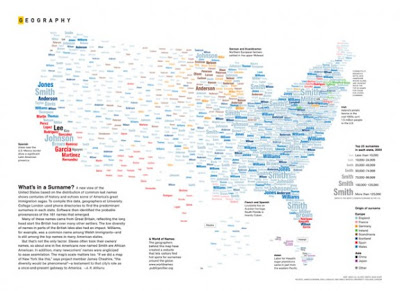
In the "Give & Take" post, I went into a small part of the importance of diamou, or tribal names, in Mali. I would often get asked if/how many diamous are in America, and I always struggled with the answer. There are of course the Native American tribes, but I don't think there is the same kind of joking relationships that Malian tribes enjoy, and lumping all the anglos together doesn't do justice to the variety therein. Last names, on the other hand, seem too numerous to really create the same kind of team mentality that seems to be inherent to the diamou.

I don't know if this map will totally answer the question, but it goes a long way. It's a geographical tag cloud of last names, color-coded by ethnic origin. Pretty cool.
Sunday, January 16, 2011

The 20/20 Peace Corps report

I was horrified by the terrible crimes reported by ABC News last week. What happened to those women is a tragedy and they are incredibly brave for sharing their stories. I am troubled, too, by the apparently apathetic and negligent treatment of the incident by the Peace Corps staff in the countries concerned. While the official statement addresses some of these concerns, I'll be looking forward to further action in response to those allegations.

In the meantime, I've gathered from various comment threads and personal conversations that the general reaction to these reports includes a tendency to presume that Peace Corps service inherently carries greater risk for sexual assault and rape relative to life here in the United States. I don't believe this is the case.

According to the ABC report, there have been about 1,000 cases of sexual assault and rape reported by Peace Corps volunteers over the last decade. About 3,500-4,000 Peace Corps trainees go abroad every year. For the sake of argument, let's make the conservative assumption that only half of these 3,500 trainees are women. (In reality, 60% all volunteers are women - most, but not all of which are recent college graduates.) 1,000 incidents over a ten year period among 17,500 women over comes to a 5.7% rate of incidence. Compare this to the United States, where up to 25% of college age women report surviving rape or attempted rape since their 14th birthday. (14-22 is only 8 years, but it's been a while since I took stats, so I'm not sure how to correct for this. Regardless, the absolutely correct value would never approach 5.7%.) I've been told that the statistics for murder and assault are similarly lopsided.

So let us not confuse the issue. As I said, the reported unresponsiveness and victim-blaming of the local staff is of great concern and deserves scrutiny. But there is nothing inherently unsafe about being abroad or working as a Peace Corps volunteer. The same terrible things can and do happen here, and it's just as tragic.

Monday, October 04, 2010

Coups in the News

'Cus even in Madagascar,
we'll find some shack below radar

-Gogol Bordello

Back in early 2009, when things were beginning to turn sour in Madagascar, I remember being frustrated when Google news couldn't feed my information addiction regarding the pending coup. English-language articles that came up from a search of 'Madagascar' were mostly about the release of 'Madagascar: Escape 2 Africa.' Though this would soon be hilariously ironic, I couldn't figure out why this was more news-worthy than a tempest of cyclones, looting and massacres. I still don't know why it didn't get covered as extensively as it might have, but I've been looking at Google trends, and it seems to validate that it was bad coverage, and not my information withdrawal, that sent me into such anxious fits at the internet cafe.

Here's the first plot, showing web traffic and news reports for Madagascar since 2004, to give you an idea of how coverage of the movies compares to the coup. (Click on any of the images below for a larger view.)


The first thing to notice is the relative size of the peaks in overall traffic, at 'A' and 'B,' to the average level of traffic and subsequent coup traffic. Notice that peak A is quite wide -- beginning around the 'Madagascar' release on May 27, 2005 and taking until mid-2006 to return to a normal traffic level. It also has a secondary peak corresponding to the DVD release on November 15, 2005. Since the release of the second film overlapped with the period of turmoil, we'll just have to assume that the traffic peak for the second movie at 'B' has similar traits. This means that when we look at traffic for 2009, the high baseline at the beginning of the year is mostly residual activity from the movie release on November 7, 2008.
Also worth mentioning is that the news coverage, shown on the bottom line, was fairly responsible -- small peaks for the movies relative to the day of the coup.

This next figure we zoom in on 2009. Remember, the high traffic volume at the beginning of the year is residual buzz from the movie.


Here we see some stranger behavior from the news publishers. There's a small hiccup in late January, when the looting and shootings took place, which in my mind were the most intense moments of the period. Yet the greatest news activity only happened when the president peacefully stepped down on March 17.

So far, we've seen that web users care more about movies than Malagasy murders, regardless of how much noise the news makes. We also might hypothesize that the internet-based media mailed this one in. It missed all the real action and mostly covered an event that was pretty much a forgone conclusion in the minds of anyone paying attention. But is this true everywhere? How do other coups stack up?

Honduras suffered a coup in June 2009, just 3 months after Ravolomanana stepped down. I've graphed activity for Honduras and Madagascar in 2009 on the same chart so that we can see the relative intensity of the coverage.


All of a sudden, that huge spike on March 17 looks like a speed bump next to the Honduran Himalayas. This makes sense. To get to Madagascar from the east coast of the United States, you need 19 hours and $5000. Also there are probably more American expats in Honduras and Honduran expats in America than is the case for Madagascar. You can't report what you don't see.

But come on - there were more articles written in
Romanian than in English about the crisis in Madagascar. Romanian! I don't even want to think what that would look like in terms of articles per fluent capita!

Certainly, there's a lot this data can't account for. (Was the coup in Honduras more unexpected and sensational? Is there a disparity of the level of access to telecommunications in the two countries? What effect did World Cup qualifiers have on the traffic?) But I can't help but wonder if there's a certain amount of negligent laziness that determines the news we see and the news we don't. What do you think? And seriously, what's the deal with the Romanians?

Monday, June 28, 2010

Leaving

“We can break the rules like nothing will last.
You might forget the sound of a voice,
Still you should not forget the things that we laughed about.”

-LCD Soundsystem

“Friendship sucks.”

-Dugukolo Coulibaly


Goodbyes are never easy, and this was no exception. I cried. Everyone cried. And in Mali, crying is intolerable, so we all had to tell each other how badly we were behaving. I’ll miss N’gabakoro deeply. And that’s all I have to say about that.

Monday, December 14, 2009

Normalizing

It had been a bad week. I’d just recovered from another bout of diarrhea. This one even made the Peace Corps doctor say ‘ew’ when I described my symptoms to her over the phone. Maybe the poor woman was eating breakfast or something; I never think of these things in time.


After dinner, Bafing, Na, BablĂ© and I were sitting around the after dinner fire. I was feeling pretty spiffy, first for the renewed control of my bowels (I can poop and fart… separately?! Great!) and second because I was sporting the new shuka wrap that Tara had given to me in Tanzania. The season had turned colder, but it was still a fur piece from being cold. The plaid blanket wrap gained a lot of attention – not for it’s clever pattern, exotic origin, or culturally accurate drape, but for the simple fact that I was wearing it. “Madou,” they’d ask, each in turn, “are you…cold?


Now, as a native of Michigan – an Arborigine goddammit! – and a part-time Yooper, it’s my birthright to deny, or at least impugn the existence of cold anywhere else on the planet, particularly in the bloody tropics. I’d already gone to great lengths to explicate my standards for cold:


Little pieces of ice fall from the sky and pile up on the ground until people get lost in it! We put metal ropes on our car tires that bite the ice so we can go places. Some people don’t have houses and burn garbage to stay warm. And, when the river freezes, some crazy people build small houses on the ice, drill holes in it and wait for stupid fish to jump out of the cold water below!


So, “No,” Madou lies, “I already told you, cold doesn’t exist in Mali. I just like my blanket.”


This precipitates a conversation that reveals one of the most perplexing misconceptions about America I’ve yet had to face. Are you ready?


Mali’s cold is bad.

America's cold is good.


By this point I’ve already talked down ridiculous claims like "America is rich is that she prints all of the world’s money," and "Mali can’t manufacture airplanes because America won’t teach her" and "Michael Jackson took medicine to turn white because he didn’t like being black" and even "George W. Bush personally executed Saddam Hussein." But this one left me speechless. So I asked Bafing what he means. He said that no matter how bad it is outside, the cold doesn’t get in our houses. He said that we don’t have dust storms that make people sick. He said that if we do get sick there's cheap and unexpired medication we can take that lets us do our work anyway. By the time he's done, I’ve privately admitted to myself that even our friends in the economically challenged Upper Peninsula have it pretty good. But I’ve made little to no headway conveying the hardships faced by snowbound Americans. Part of this is due to my linguistic shortcomings, but I have a tendency to make this harder for myself than it needs to be. My anecdote about Hugo Chavez's donations of heating oil to the snowbound northeast was especially confused.


But through these conversations I also begin to see an upside to the ridiculous barriers our government puts in place to limit immigration to the educated elite. Sometime you should ask someone from a less developed country what they had to do to get their visa, you'll be astounded by the barriers they have to overcome. But in some ways, it serves a purpose. By the time someone has money, computer skills, and contacts in the United States, their dreams of America tend to be fairly grounded in reality. Yes, it's a place where opportunities exist, but they’re not distributed evenly. Yes, there is wealth, but there is also poverty, disease, xenophobia and even racism. Even the ones who eventually make it over still have a hard go of it. But every time I try to explain this to the proponents of the Candyland vision of America, they flatly deny it. This kind of reaction has the power to still even the most vivacious and fluent tongues. It’s like if you told a group of children that the Easter Bunny isn’t real, only to have them snap back in unison, “Don’t be silly. You’ll find out one day.”


You start to ask yourself, what is it they know???


Speaking of the Easter Bunny, this spring I’ll get my 3rd chance to explain the American Easter tradition. Given that “pretend” or “make-believe” aren’t in my Bambara vocabulary, what do you suppose it will do to their vision of Paradise? I can see it now. Years down the road they'll be telling each other Madou said that in America they have giant bunnies. And that every year, they sneak into your house and hide colorful chocolate-filled eggs in every corner because… what did Madou say? Jesus died for us sinners? Amen and hallelujah! I guess we Americans are capable of some pretty stunning self-deception, too.


Bafing and I were neck deep in the Chavez fiasco when it happened. Out of the darkness, a man rolled up on a bicycle. At first glance he was a dead ringer for a WWI pilot, except his bomber jacket was nylon and his aviator’s cap was actually a disembodied hood from some other jacket, the drawstring fastened under his chin. The rest was pretty spot-on – everything from the scarf foppishly tossed over one shoulder, right down to his knickers that were ballooning out of pointed leather boots. For extra flair, he’s got an 8-inch knife sheathed at his waist, a shotgun on his back and what appears to be a headlight stripped from a car and strapped around his forehead with an old bicycle inner tube. (Handy tip: These inner tubes, cut into strips, are used and reused for purposes as sundry as our uses of duct tape.) After the perfunctory greetings, he asked if anyone had an axe. Without a word, BablĂ© fetched one from inside the house. The pilot held the axe in front of him, looking at it approvingly - yes, this will do. Then he un-mounted the blade, returned the handle, and disappeared into the night.


What struck me as odd about this is that nothing at all about this struck me as odd.


My point being, whether it’s the hot (not cold!) weather, the improbable loads carried on the backs of bicycles or on the heads of women, or the perfectly bizarre creature that is The Donkey, I’m getting used to life here. I guess it’s a good sign that I'm comfortable with my environment.But at the same time, it makes it harder to recognize the "unrelatable" moments, and sharing the things I’ve made sense of seems less urgent. So sorry for that. And sorry again for when I come back to the States and laugh at all the wonderfully absurd things we do.


Birdbaths… bwaaa ha ha ha ha!


Thursday, August 20, 2009

Give & Take

Written July 15

Pandemonium!!

It’s a like a Wall St. fire drill. Shoving, shouting, and a powerful tide of people running and brushing past from every direction. Peace Corps had warned us not to come here. I’m constantly rubbernecking to keep track of the other volunteers and scanning the crowd as we try to cut across the undertow, but Peace Corps’s advice is kept far from my mind. I’m too busy looking for what everyone is after– a cool drink of water.

It’s halftime at the Mali-Ghana soccer match, and we’re circling the concourse outside the stadium. The sun went down around the twenthy-fifth minute, but the pre-game hours of line standing and seat saving has left me - and 30,000 of my closest friends - a bit parched.

I can say with some confidence that these entirely non-threatening skirmishes were not what PC had in mind when they questioned the wisdom of going to a World Cup qualifier in West Africa, especially when the visitors are heavily favored to win. In fact, just last year a number people got trampled at this very same stadium - and that was just an Alpha Blondy concert!

But here, all has been law and order. The pre-game traffic wasn’t any heavier than you might expect in the States, but the fast and (literally) loose passenger safety regulations meant hundreds of pick-up trucks and vans with dozens of people overflowing from every door, window roof and bumper, each one clutching on to ‘post-market’ and ‘user-installed’ oh-shit bars. Impressive, too, was the line outside the stadium. Lacking any snaking corrals to keep the line compact and single file, a tight line coiled around the stadium. Strangers stood chest to back for easily a kilometer. Police enforced no-go zones on either side of the line by blindly swinging clubs like General Grievous as they paced up and down either side of the line. Those who thought they were too good to conga with the rest of us were quickly corrected. One-and, two-and, one, kick!

And even the current brouhaha isn’t all tooth-and-claw greed. My friends wave me to the outside wall of the concourse overlooking the property behind the stadium. Then I see them – thousands of men, shoeless and prostrate in prayer. Whatever residual tension I'm harboring downshifts two gears. In Madagascar, my friends and I would have had to Houdini out of potentially thousands of handshake manacles and suffocating vapor clouds of ethanol. But not here - every Muslim in sight is sober. The most we'd have to worry about was staying out of the way as they race into the bathrooms, roll up their pant legs and crowd the sinks for the ablutions. After all, Allah waits for no conga line.

As I'm taking in the view, man brushes past, his arms full of the coveted polyethylene pouches of water. The American in me immediately thinks scalper! and I chase after him. When I ask him if he’s selling, he smiles, shakes his head. In an archetype of Malian patience, tries to push one into my hand.

In Mali, it’s impolite to refuse a gift, something that I tend to forget. For example, one morning in Koulikoro, the capital of my region, I’d walked downtown to get breakfast from possibly the best meat & egg sandwich stand in Mali. The woman makes this onion sauce that is at once an aphrodisiac in the short term and a guarantor of abstinence in the long.

On the way, I practiced an obligatory gesture I learned in Madagascar but perfected in Mali – greeting. It usually goes something like this:

Good morning! How’d you sleep? How are you? How’s your family? My name? Madou Coulibaly.

From here, it can go one of two ways. If they, like me, are a Coulibaly, we wish each other a nice day and I’m on my way. If they go by any other last name, I’m told in the warmest tones and with the heartiest of handshakes that I am an uncircumcised slave donkey who farts a lot, or some permutation thereof. It’s a complicated relationship.

I'd finally made it to the sandwich stand and had begun the trip back home. I'm cradling the warm sandwich like a football to keep any onion sauce from escaping the baguette. One of the not-Coulibalys I identified earlier hollered from across the street. Where are you going with that? Coulibalys are too poor for anything but beans! Give it here. Feeling a little insult fatigue, I decided to call her bluff. I crossed the street, marched up the steps and I was halfway into my play-action pass before I realized it wasn't what either of us had intended. But it's too late. So inexorably, with my confusion mirrored in her face, she took the sandwich.

Likewise, back at the soccer game, with a well-practiced smile of resigned gratitude, I take the water.

****************


Mali eventually lost, 2-0, so thankfully halftime was as lively as things got for us. Granted, we left after the second goal, and even then we had to battle our way through congested streets with no public transport in sight. We had the good fortune of being picked up by a Malian couple driving a luxury SUV paid for in diamonds. “It's nothing,” the woman said. “Somewhere in America, I’m sure someone is doing the same for a Malian.” My mind ran through the particulars of a wealthy American couple picking up five West Africans from the streets of DC in the dark of night, and I briefly considered contending her assertion. Once again, good fortune intervened and a combination of inadequate Bambara and nearly adequate judgment kept my tongue in check. It’s easier to pay it forward from here.


But why did it have to be the sandwich!?

De-Consolidation Homesick Blues

Written March 2, 2009

I’ll admit, I flipped the switch too early. Sometime during that bumpy, dusty, overnight truck ride, my imagination betrayed me.

Under normal conditions, it takes 11 hours to get from Fianar from Ikongo. That night it took 16, so I had plenty of time to explore all the implications of the inevitable hypothesis of what if this is goodbye? By the time we got to Fianar, I’d worked out so many contingencies, wrapped my head so tightly around the idea of evacuation that I forgot to leave room for any other eventuality.

And who can blame me? Who doesn’t want that narrative? I, a worker for peace, had to be dragged across a tarmac and into a plane while the country self-destructed around me! Who doesn’t want to step out of Reagan National Airport in the middle of February shod in flip flops, unshaven and jacketless because… well, dammit, that’s all the time there was!

So, you understand, during those three weeks of excruciating uncertainty and mind-rattling ambiguity, my stomach tweaked itself a notch tighter every time it looked like my life might not be as exciting as I had imagined. Going back to my village of Ambolomadinika became inconceivable.

I was afraid it’d be weird. That things would be intrinsicially different now that the fragile nature of the relationships I’d built had been laid bare. Afraid that they’d resent me for being a needle drop away (get it? Because Andry is a former disc j—ah, forget it) from writing the whole thing off as an aborted vacation. Afraid that all my half-baked projects would fall apart. They probably will anyhow, but this at least would have given me a scapegoat.

But here’s the punchline, O Patient Reader: Nothing has changed. If anything, things have gotten better. I feel much less obligated to put up with people who only see me as a walking sack of money. Mind you, there are still annoyances. The madness caused by too much time in your head, the stark differences in expectations, the day to day cultural subtleties I’m sure to never truly grasp. They’re all still there. But these annoyances are part of a routine deep enough to swim in and solid enough to stand on. They are family.

Like too many of us, I’ve been to the edge of life-altering moments before and experienced the pre-emptive (perhaps artificial?) hindsight that refocuses and revitalizes the old reality. It’s happened often enough that I reluctantly acknowledge that this new frame of reference will relax into the old. The head time, expectations and culture will likely prevail, and soon enough I’ll be back to staining the pages of my journal blue with ball-point fury. At least until experience and time bring genuine hindsight. The principle behind every Peace Corps service is the hope that this happens before you become an RPCV.

I found this in one of the notebooks I packed out of Madagascar. I wrote it the interim between consolidation and evacuation. I'd intended to upload it during my next trip to Fianar.